
Executive Summary of the TG ICET 2026 Academic Cycle
The Telangana State Integrated Common Entrance Test, widely known as TG ICET 2026, is the mandatory state-level entrance examination for graduates seeking admission into Master of Business Administration (MBA) and Master of Computer Applications (MCA) programs across universities in Telangana and their affiliated colleges. For the academic cycle of 2026–27, Mahatma Gandhi University, Nalgonda, administered the online computer-based examination on behalf of the Telangana Council of Higher Education (TGCHE). Formerly designated as TS ICET, the exam underwent an official renaming to TG ICET to align with state nomenclature updates, though the core syllabus, structure, and academic evaluation standards remained identical to previous iterations.
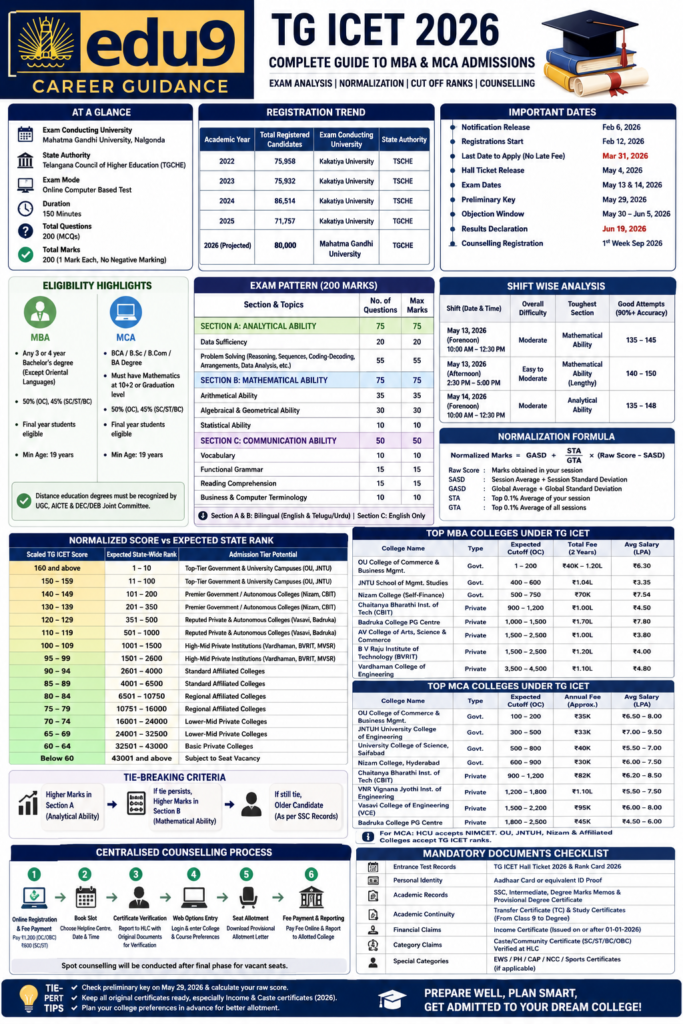
Understanding the fluctuations in candidate participation is essential for assessing competition levels. The volume of registrations directly influences the standard deviation of scores, which plays a major role in the normalization of marks across exam shifts. The table below outlines the historical candidate registration trends for the state entrance examination.
| Academic Year | Total Registered Candidates | Exam Conducting University | State Authority |
| 2022 | 75,958 | Kakatiya University | TSCHE |
| 2023 | 75,932 | Kakatiya University | TSCHE |
| 2024 | 86,514 | Kakatiya University | TSCHE |
| 2025 | 71,757 | Kakatiya University | TGCHE |
| 2026 | 80,000 | Mahatma Gandhi University | TGCHE |
The drop in registration volumes observed in 2025 created a highly favorable competitive environment for test-takers, resulting in minor downward shifts in the cutoff ranks of several top-tier colleges. For the 2026 cycle, candidate participation stabilized near the projected mark of 80,000, presenting a balanced competitive environment. The examination has concluded, and candidates are transitioning into the post-exam phase. This stage includes evaluating preliminary answer keys, submitting objections, and preparing for the centralized web-based counseling process.
Official Chronological Timeline and Extension Metrics
To manage the high volume of candidates and ensure administrative transparency, the TGCHE structured the 2026 admission cycle with specific deadlines. To prevent candidate exclusion and maximize access, the state council extended the regular registration deadline from its original date of March 16, 2026, to March 31, 2026. This extension adjusted the subsequent late-fee registration structure, giving candidates extra time to apply while managing late-fee penalties.
The official timeline below details the final chronological schedule for the TG ICET 2026 cycle, from the initial notification to the commencement of centralized counseling.
| Milestone Event | Scheduled Date / Operational Timeline | Administrative Fee Details |
| Official Notification Release | February 6, 2026 | N/A |
| Commencement of Online Registrations | February 12, 2026 | Regular Fee: ₹750 (General), ₹550 (Reserved SC/ST/PH) |
| Last Date to Apply (No Late Fee) | March 31, 2026 (Extended from March 16) | Regular Fee: ₹750 (General), ₹550 (Reserved) |
| Registration with Late Fee Level I | April 15, 2026 | Regular Fee + ₹250 Late Fee |
| Application Correction Window | April 18, 2026 to April 26, 2026 | Free of Charge (Selective Fields) |
| Registration with Late Fee Level II | April 25, 2026 | Regular Fee + ₹500 Late Fee |
| Registration with Late Fee Level III | May 1, 2026 | Regular Fee + ₹5,000 Late Fee |
| Last-Minute Registration Window | May 2, 2026 to May 3, 2026 | Regular Fee + ₹10,000 Late Fee |
| Official Hall Ticket Release | May 4, 2026 | N/A |
| Entrance Examination (Day 1 – Shifts 1 & 2) | May 13, 2026 | N/A |
| Entrance Examination (Day 2 – Shift 3) | May 14, 2026 | N/A |
| Release of Preliminary Key & Response Sheets | May 29, 2026 | Available on official website: icet.tgche.ac.in |
| Objection Window Against Preliminary Key | May 30, 2026 to June 5, 2026 | ₹500 Processing Fee per challenged question |
| Declaration of Results & Final Normalized Ranks | June 19, 2026 | N/A |
| Centralized Counselling Registration (Phase I) | First week of September 2026 | Counseling Fee: ₹1,200 (General), ₹600 (SC/ST) |
Program-Specific Academic Eligibility and Prerequisite Framework
Candidates seeking admission through TG ICET 2026 must meet distinct academic eligibility criteria set by the TGCHE. These criteria ensure that candidates have the necessary foundational preparation required for rigorous postgraduate study in business and computer applications. The base eligibility rules mandate Indian nationality and local/unreserved residency status in Telangana or Andhra Pradesh as defined by relevant Government Orders.
The academic prerequisites differ significantly between the MBA and MCA programs.
| Academic Parameter | Master of Business Administration (MBA) | Master of Computer Applications (MCA) |
| Undergraduate Degree Requirement | Passed any recognized 3-year or 4-year Bachelor’s degree (BA, BSc, BCom, BBA, BBM, BCA, BE, BTech, BPharmacy, etc.). | Passed BCA, BSc, BCom, or BA. |
| Academic Discipline Restrictions | Open to all undergraduate fields, excluding Oriental Languages. | Open to specified fields; candidates must have studied Mathematics at the 10+2 level or the graduation level. |
| Minimum Qualifying Marks | Unreserved (OC): 50% aggregate. Reserved (SC/ST/BC): 45% aggregate. | Unreserved (OC): 50% aggregate. Reserved (SC/ST/BC): 45% aggregate. |
| Distance Education Restrictions | Degrees earned via Distance Mode or Open Distance Learning (ODL) must be recognized by the Joint Committee of UGC, AICTE, and DEC/DEB. | Degrees earned via Distance Mode or Open Distance Learning (ODL) must be recognized by the Joint Committee of UGC, AICTE, and DEC/DEB. |
| Age Limit Criteria | Minimum age of 19 years as of the official notification date; no upper age limit is prescribed. | Minimum age of 19 years as of the official notification date; no upper age limit is prescribed. |
Candidates currently in their final year of graduation are also eligible to apply, provided they complete their degree requirements and submit proof of passing during the centralized certificate verification process.
Structural Layout of the TG ICET Exam Pattern and Sectional Weightage
The TG ICET 2026 exam was administered as a 150-minute computer-based test. The exam pattern featured 200 multiple-choice questions (MCQs), with each question worth one mark and no penalties for incorrect or unanswered questions.
The raw score calculation is straightforward:
$$\text{TG ICET Raw Score} = 1 \times C + 0 \times I$$
Where $C$ represents the number of correct responses and $I$ represents incorrect or unattempted questions. Since there is no negative marking, candidates are encouraged to attempt all 200 questions. The test paper is divided into three sections: Analytical Ability, Mathematical Ability, and Communication Ability.
The table below provides a detailed breakdown of the syllabus and sectional weightage for the TG ICET 2026 exam.
| Test Sections & Subsections | Core Target Areas & Syllabus Topics | Question Count | Max Marks |
| Section A: Analytical Ability | 75 Qs | 75 Marks | |
| Data Sufficiency | Evaluating whether given statements provide sufficient data to answer logical and mathematical queries. | 20 Qs | 20 Marks |
| Problem Solving | Sequences and Series, analogies, odd one out, coding-decoding, blood relations, calendars, clocks, seating arrangements, and data analysis (venn diagrams, pie charts, tables, bar graphs). | 55 Qs | 55 Marks |
| Section B: Mathematical Ability | 75 Qs | 75 Marks | |
| Arithmetical Ability | Laws of indices, surds, ratio and proportion, divisibility, LCM & GCD, percentages, profit & loss, partnerships, time-speed-distance, and work-time problems. | 35 Qs | 35 Marks |
| Algebraical & Geometrical Ability | Coordinate geometry, triangles, quadrilaterals, circles, trigonometric applications, polynomials, linear equations, progressions, sets, relations, and functions. | 30 Qs | 30 Marks |
| Statistical Ability | Frequency distributions, mean, median, mode, standard deviation, and elementary probability. | 10 Qs | 10 Marks |
| Section C: Communication Ability | 50 Qs | 50 Marks | |
| Vocabulary | Direct synonyms, antonyms, and one-word substitutions. | 10 Qs | 10 Marks |
| Functional Grammar | Prepositions, articles, tenses, active/passive voice, direct/indirect speech, and phrasal verbs. | 15 Qs | 15 Marks |
| Reading Comprehension | Reading text passages and answering inferential questions. | 15 Qs | 15 Marks |
| Business & Computer Terminology | Computer hardware/software basics, networking, internet, budget, marketing, and economic terms. | 10 Qs | 10 Marks |
To accommodate candidate preferences, Section A and Section B are bilingual (English and Telugu or English and Urdu). Section C is administered strictly in English, as it tests candidates’ english communication and vocabulary skills.
Shift-Wise Post-Exam Difficulty Analysis and Good Attempts
The three exam shifts of TG ICET 2026, held on May 13 and May 14, showed distinct structural variations. This highlights the importance of the normalization process in leveling the playing field for candidates across different shifts.
The table below summarizes shift-specific difficulty levels, toughest sections, and recommended good attempts.
| Exam Shift Date & Time | Overall Difficulty | Toughest Section | Easiest Section | Recommended Good Attempts (90%+ Accuracy) |
| May 13, 2026 (Forenoon) 10:00 AM – 12:30 PM | Moderate | Mathematical Ability | Communication Ability | 135 – 145 attempts |
| May 13, 2026 (Afternoon) 2:30 PM – 5:00 PM | Easy to Moderate | Mathematical Ability (Lengthy) | Communication Ability | 140 – 150 attempts |
| May 14, 2026 (Forenoon) 10:00 AM – 12:30 PM | Moderate | Analytical Ability | Communication Ability | 135 – 148 attempts |
On Day 1 (May 13, 2026) Shift 1, the Mathematical Ability section was reported as the toughest and most time-consuming. While basic arithmetic questions were manageable, algebra and mensuration problems required detailed and lengthy calculations. Candidates noted that several geometry and algebra problems drew from Class 12-level concepts, making this section more challenging.
In contrast, the Analytical Ability section was moderately manageable, though arrangements and data sufficiency questions required careful analysis. The Communication Ability section was highly scoring, featuring basic computer fundamentals and straightforward reading comprehension passages.
Day 1 Shift 2 followed a predictable pattern with no major surprises, resulting in a moderate-to-easy difficulty rating.
Day 2 (May 14, 2026) featured a single forenoon shift. Test-takers on this day found the Analytical Ability section to be the trickiest and most calculation-intensive. Tricky reasoning sets, complex seating arrangements, and detailed data sufficiency queries made this section highly time-consuming. Meanwhile, both the Mathematical and Communication Ability sections were reported as highly manageable.
Mathematical Mechanics of the TG ICET Normalization Process
Because TG ICET 2026 was conducted across multiple shifts with different question papers, the difficulty standards naturally varied. To ensure a fair evaluation of all candidates, the TGCHE uses a normalization process. Normalization adjusts raw scores to a common scale, ensuring that no candidate is advantaged or disadvantaged by the relative difficulty of their assigned shift.
Mahatma Gandhi University, Nalgonda, uses the following normalization formula to calculate a candidate’s final scaled marks :
$$\text{Normalized Marks} = \text{GASD} + \left \times (\text{Raw Score} – \text{SASD})$$
Where the variables are defined as:
- $\text{Raw Score}$: The actual marks secured by the candidate in their specific exam session.
- $\text{SASD}$ (Session Average and Standard Deviation): The sum of the average and the standard deviation of all candidates who wrote the exam in that specific session.
- $\text{GASD}$ (Global Average and Standard Deviation): The sum of the average and the standard deviation of all candidates across all sessions of the entrance exam.
- $\text{STA}$ (Session Top Average): The average score obtained by the top 0.1% of candidates who attempted that specific exam session.
- $\text{GTA}$ (Global Top Average): The average score obtained by the top 0.1% of all candidates across all exam sessions combined.
This formula adjusts raw scores by comparing individual performance against shift-specific and overall cohort metrics. If a candidate from a reserved category (exempt from minimum qualifying marks) achieves a negative score after normalization, their score is adjusted to zero. However, in case of a tie, the negative normalized score is preserved in its fractional state to resolve the tie.
Normalized Marks vs Expected State Ranks Analysis
Ranks are assigned based on normalized scores, which determine a candidate’s placement in the state merit list and eligibility for top-tier colleges. The qualifying cutoff is 25% (50 marks out of 200) for general and OBC candidates, while reserved category candidates require no minimum qualifying marks.
The table below provides expected normalized marks-to-rank projections based on the 2026 cycle.
| Scaled TG ICET Score | Expected State-Wide Rank | Admission Tier Potential |
| 160 and above | 1 to 10 | Top-Tier Government and University Campuses (OU, JNTU) |
| 150 to 159 | 11 to 100 | Top-Tier Government and University Campuses (OU, JNTU) |
| 140 to 149 | 101 to 200 | Premier Government/Autonomous Colleges (Nizam, CBIT) |
| 130 to 139 | 201 to 350 | Premier Government/Autonomous Colleges (Nizam, CBIT) |
| 120 to 129 | 351 to 500 | Reputed Private & Autonomous Colleges (Vasavi, Badruka) |
| 110 to 119 | 501 to 1000 | Reputed Private & Autonomous Colleges (Vasavi, Badruka) |
| 100 to 109 | 1001 to 1500 | High-Mid Private Institutions (Vardhaman, BVRIT, MVSR) |
| 95 to 99 | 1501 to 2600 | High-Mid Private Institutions (Vardhaman, BVRIT, MVSR) |
| 90 to 94 | 2601 to 4000 | Standard Affiliated Colleges |
| 85 to 89 | 4001 to 6500 | Standard Affiliated Colleges |
| 80 to 84 | 6501 to 10750 | Regional Affiliated Colleges |
| 75 to 79 | 10751 to 16000 | Regional Affiliated Colleges |
| 70 to 74 | 16001 to 24000 | Lower-Mid Private Colleges |
| 65 to 69 | 24001 to 32500 | Lower-Mid Private Colleges |
| 60 to 64 | 32501 to 43000 | Basic Private Colleges |
| Below 60 | 43001 and above | Subject to Seat Vacancy |
State-Prescribed Tie-Breaking Hierarchy
In instances where multiple candidates obtain identical normalized scores, the following tie-breaking criteria are applied :
- Section A Priority: Higher marks in Section A (Analytical Ability).
- Section B Priority: If the tie persists, higher marks in Section B (Mathematical Ability).
- Age Seniority: If scores remain tied, the older candidate is given preference, calculated based on secondary school certificate records.
ROI Analysis of Top MBA and MCA Colleges Under TG ICET
Evaluating the Return on Investment (ROI) is crucial for candidates comparing top-tier government and private colleges accepting TG ICET scores. Government-affiliated institutions feature low tuition fees alongside solid placement packages, while premier private colleges offer extensive corporate networking and modern infrastructure.
The tables below detail expected cutoffs, fees, and average salary packages for top-tier MBA and MCA programs.
Top MBA Colleges Under TG ICET
| Business School Name & Campus Location | College Type | Expected Cutoff (OC) | Total Course Fee (2 Years) | Avg Salary Package (LPA) |
| OU College of Commerce & Business Mgmt. | Government | 1 – 200 | ₹40,000 – ₹1,20,000 | ₹6.30 LPA |
| JNTU School of Management Studies | Government | 400 – 600 | ₹1,04,000 | ₹3.35 LPA |
| Nizam College (Self-Finance) | Government | 500 – 750 | ₹70,000 | ₹7.54 LPA |
| Chaitanya Bharathi Inst. of Tech (CBIT) | Private | 900 – 1,200 | ₹1,00,000 | ₹4.50 LPA |
| Badruka College PG Centre | Private | 1,000 – 1,500 | ₹1,70,000 | ₹7.80 LPA |
| AV College of Arts, Science & Commerce | Private | 1,500 – 2,500 | ₹1,00,000 | ₹3.80 LPA |
| B V Raju Institute of Technology (BVRIT) | Private | 1,500 – 2,500 | ₹1,20,000 | ₹4.00 LPA |
| Vardhaman College of Engineering | Private | 3,500 – 4,500 | ₹1,10,000 | ₹4.80 LPA |
Top MCA Colleges Under TG ICET
| Computer Applications Institute Name | College Type | Expected Cutoff (OC) | Annual Tuition Fee (Approx.) | Avg Salary Package (LPA) |
| OU College of Commerce & Business Mgmt. | Government | 100 – 200 | ₹35,000 | ₹6.50 – ₹8.00 LPA |
| JNTUH University College of Engineering | Government | 300 – 500 | ₹33,000 | ₹7.00 – ₹9.50 LPA |
| University College of Science, Saifabad | Government | 500 – 800 | ₹40,000 | ₹5.50 – ₹7.00 LPA |
| Nizam College, Hyderabad | Government | 600 – 900 | ₹30,000 | ₹6.00 – ₹7.50 LPA |
| Chaitanya Bharathi Inst. of Tech (CBIT) | Private | 900 – 1,200 | ₹82,000 | ₹6.20 – ₹8.50 LPA |
| VNR Vignana Jyothi Inst. of Engineering | Private | 1,200 – 1,800 | ₹1,10,000 | ₹5.50 – ₹7.50 LPA |
| Vasavi College of Engineering (VCE) | Private | 1,500 – 2,200 | ₹95,000 | ₹6.00 – ₹8.00 LPA |
| Badruka College PG Centre | Private | 1,800 – 2,500 | ₹45,000 | ₹4.50 – ₹6.00 LPA |
For MCA admissions, the University of Hyderabad (HCU) accepts NIMCET scores, whereas Osmania University, JNTUH, Nizam College, and affiliated institutions strictly require TG ICET ranks.
Centralized Counselling Framework and Certificate Verification Protocol
Following the announcement of results on June 19, 2026, the TGCHE will initiate centralized web-based counseling. The counseling process is divided into multiple phases to efficiently manage seat allocation across participating institutes.
Step-by-Step Counselling Procedure
The centralized web-based counseling process involves the following key steps:
- Online Registration and Processing Fee Payment: Candidates register on the official counseling portal by entering their TG ICET Hall Ticket Number, Registration Number, and Date of Birth. They must pay a non-refundable processing fee of ₹1,200 for General/OBC categories or ₹600 for SC/ST categories via online payment.
- Helpline Centre Slot Booking: Once the fee is paid, candidates select a preferred Helpline Centre (HLC), date, and time slot for in-person document verification.
- Physical Certificate Verification: Candidates must report physically to their chosen HLC during their selected slot, bringing all required original documents and photocopies. Counseling officials cross-verify the documents and issue an official receipt-cum-verification form.
- Web Options Entry: After successful document verification, a unique login ID is sent to the candidate’s registered mobile number. Candidates log in to create a password and enter their preferred choices of colleges and programs in order of priority.
- Provisional Seat Allotment: Ranks, category reservations, and web preferences are processed to determine seat allocation. Candidates can then download their official seat allotment letter from the portal.
- Tuition Fee and Reporting: To confirm the seat, candidates must pay the prescribed tuition fee online and report physically to the allotted college within the specified timeline.
Mandatory Documentation Checklist
To avoid administrative delays or cancellation of allotment, candidates must present genuine, original documents along with multiple photocopies during verification. The required documents are detailed in the table below.
| Document Category | Specific Certificates Required | Key Administrative Conditions |
| Entrance Test Records | TG ICET Hall Ticket 2026 & Rank Card 2026. | Must feature valid signatures from exam invigilators. |
| Personal Identity | Aadhaar Card or equivalent government-issued ID proof. | Data must exactly match educational certificates. |
| Academic Records | SSC (Class 10) & Intermediate (Class 12) marks memos, along with the Consolidated Degree Marks Memo and Provisional Degree Certificate. | The qualifying degree must be from a UGC-recognized university. |
| Academic Continuity | Transfer Certificate (TC) & Study/Bonafide Certificates from Class 9 through the undergraduate degree. | Used to establish local state status eligibility. |
| Financial Claims | Income Certificate issued by a competent authority. | Must be issued on or after January 1, 2026, to qualify for fee concessions. |
| Category Claims | Caste/Community Certificate for reserved categories (SC, ST, BC, OBC). | Must be verified and authenticated by the Caste Verification Officer at the HLC. |
| Special Categories | EWS, PH, CAP, NCC, or Sports certificates (where applicable). | Issued by authorized departments; CAP requires a certificate from the Zila Sainik Welfare Board. |
Spot counseling is typically conducted after the final phase of counseling to fill any remaining vacant seats, particularly in private, self-financing institutions.
Strategic Admissions Outlook and Recommendations
The transition from TS ICET to TG ICET 2026 represents a structural stabilization of Telangana’s state-level postgraduate admissions system. While Mahatma Gandhi University managed the administrative and test delivery components effectively, the shifting of the regular registration deadline to March 31, 2026, highlighted the need for flexible administrative timelines. This adjustment successfully maintained candidate participation without compromising the overall schedule of the examination.
Post-exam shift reviews show that while the core syllabus remained consistent, subtle differences in difficulty persisted between exam slots. The challenging nature of the Mathematical section on Day 1 and the Analytical section on Day 2 underscore the importance of the normalization process. This protocol successfully minimizes the impact of varying test difficulty, ensuring that final state-wide rankings are determined purely on relative merit.
As the June 19, 2026, result declaration approaches, candidates are advised to prepare systematically for the upcoming admissions process. It is highly recommended to review the preliminary answer key on May 29, 2026, and download the associated response sheets. Calculating projected raw scores early allows candidates to estimate their expected ranks and begin evaluating potential colleges. Additionally, gathering all necessary original academic and category certificates—especially income and caste certificates issued within the mandated 2026 fiscal timeline—is essential to prevent delays during centralized certificate verification. Planning college preferences ahead of the web-option window will enable candidates to navigate the competitive counseling landscape successfully and secure admission into their preferred institutions